Types of Fixed Dental Prostheses
Fixed prosthodontics is the part of dentistry that replaces missing teeth with a prosthesis cemented permanently in place.
There are several ways to replace missing teeth. Fixed dental prostheses (FDPs) are fixed onto your remaining teeth or onto implants. They restore the shape, function and appearance of the missing teeth, and they are one of the most common restorations in dentistry.
Tasks:
- Restoring one or several teeth in the arch.
- Aesthetic smile
- Correcting defects
- Keeping the remaining teeth healthy.
- Regaining the chewing function.
- Comfortable communication
TYPES OF FIXED DENTAL PROSTHESES
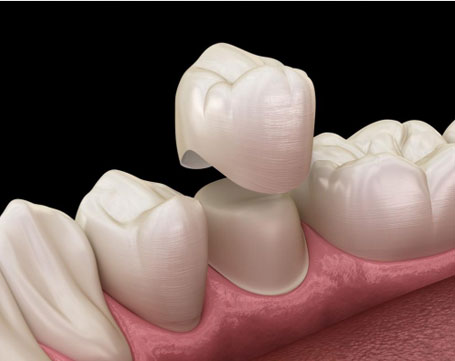
Crowns
A single prosthesis making it possible to restore teeth which are decayed more than 50%.
Materials:
Ceramics: natural colour shade, risk of chipping.
Zirconia: excellent fit, high strength, not any different from original teeth, durability.
Metal ceramics: strong and aesthetic crowns.
Gold: good fit with the tissues, hardly ever causes allergy, durable.
Chromium and cobalt one piece models: functional but problematic in terms of aesthetics
Before placing a crown, it is necessary to have the decayed tooth treated and filled; in case of a severe tissue decay, an inlay core is inserted.
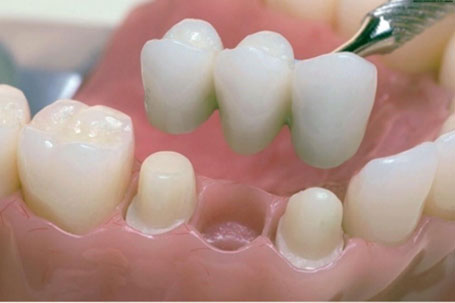
This structure is used to replace a number of missing teeth in the arch. A few crowns are linked and fixed on abutment teeth or implants.
A one piece plate is made of:
Plastic: temporary structures with low strength and poor colour shade imitation
Metal ceramics: a popular option due to high strength and looking similar to the original shape and colour shade
Alloys: super strong but not aesthetic
Ceramics: more often for a single unit restoration.
Bridgework structures are differentiated according to their fabrication method, fixation and configuration.
A more conservative option for a crown is the inlay. It is possible to provide an inlay if a relatively small amount of tooth tissue is missing within the confines of the tooth cusps. The inlay can be made from metals, resins or ceramics.
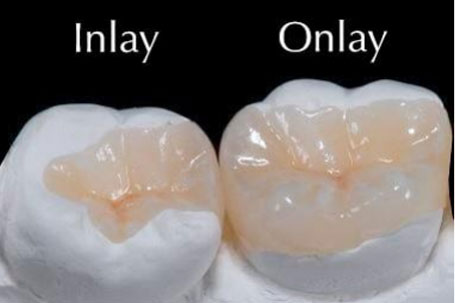
Onlay
An onlay is similar to an inlay, but it often covers over the cusps of a tooth. They are particularly useful if the tooth needs to be strengthened or reinforced. They can also be used to make the tooth longer/higher, which is useful if a worn dentition is being built back up again.
Veneer
Veneers are a type of fixed prosthetics when thin plates made of inert materials are used to cover the front of the teeth, thus creating a perfectly shaped and coloured healthy enamel analog. Bonded with cement, the structures are custom made.
Dental Implants:
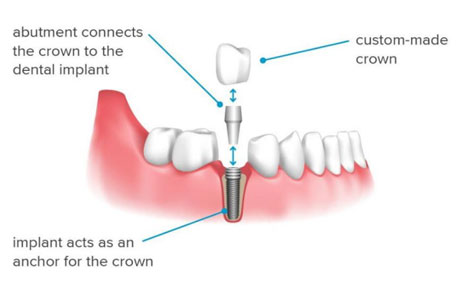
A dental implant is a structure that replaces a missing tooth. With screwlike devices, the surgeon inserts an implant into the jawbone, and it acts as an anchor for an artificial tooth, called a crown.
A device called an abutment connects the artificial tooth to the dental implant.
The crown is custom-made to fit the person’s mouth and match the color of their teeth. Crowns look, feel, and function like natural teeth.
How to take care of fixed dental prostheses
1. Giving up certain habits: husking seeds, biting nails, biting off hard thread.
2. Protecting from mechanical damage in case of bruxism – wearing a mouthguard during sleep.
3. Avoiding food colouring the enamel and cement.
4. Having regular checkups by a dentist, at least once every six months.
5. Avoiding hard food after the procedure.
6. Keeping safe from damage
At our Kondapur clinic, Dr. Paramveer Singh Malik is our prosthodontist and implantologist. You can read about him, and the rest of our dentists, on our team page. Directions and timings are on our Kondapur clinic page.
To read about crowns and bridges at the clinic, visit our crowns and bridges page.